


by Wang Kai
Emerging markets equities and bonds have delivered the strongest start of a year in over two decades.
Beyond South Korea, there has been a broad-based shift of capital into emerging markets, driven by commodity and sector-specific tailwinds, with inflows up 112% from last year. Peru ranked second, posting an approximate 100% gain. Thailand rose 11.9%, while Brazil surged 60.9%. Gold has crossed USD 5,000 per ounce, while silver is trading around USD 90 per ounce.
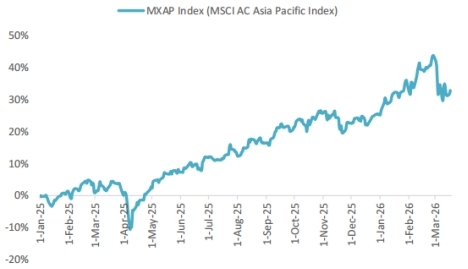
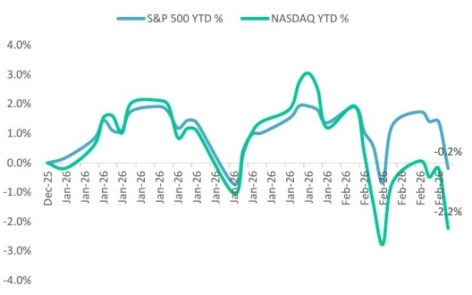
The MSCI Asia Pacific Index has risen more than 32.9% year-to-date, outperforming both the S&P 500, which is down 0.2% for the year, and the technology-heavy Nasdaq 100, which has shed around 2%. Graphic from Ktrade Securities.
“Emerging markets are reasserting their structural growth premium over developed ones, supported by stronger economic growth, improving earnings dynamics, policy flexibility, and a more favorable currency backdrop,” a recent research by KTrade Securities found.
Deterred by historically high U.S. deficits and a more inward-looking policy stance, investors are increasingly betting that corporate earnings in emerging markets will track their stronger economic growth. Investment in private credit across emerging markets reached a record USD 22.3 billion in 2025, nearly 40% above the previous peak in 2022. This surge comes as tighter bank lending conditions and a global search for yield push investors toward alternative assets, particularly as traditionally safe markets experience heightened volatility.
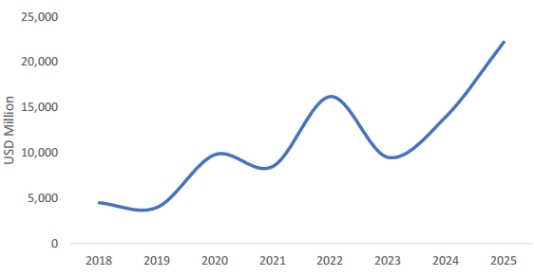
Annual Private Credit Investment in Emerging Markets. Graphic from Ktrade Securities.
AI looks east
Investor anxiety over AI disruption has emerged as an immediate factor. In the U.S., concerns that generative and agentic AI could erode profits in sectors such as software, legal services, real estate, and insurance have weighed on sentiment. Bank of America notes that the market capitalisation of the U.S. software industry has fallen by more than $2trn in just five months. Statistics released by the U.S. Department of Labor this week showed an unexpected decline of 92,000 in non-farm payrolls in February, intensifying fears that AI may begin to disrupt labour markets sooner than anticipated.
Asian equities, on the other hand, have rallied strongly on sustained demand across the AI upstream supply chain, which results in a capital rotation where global investors are reallocating funds away from U.S. AI pioneers with heavy capital spending toward Asian hardware suppliers with stronger pricing power.
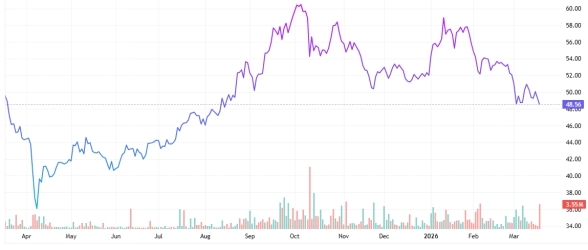
Invesco China Technology ETF performance in the 12 months to March 19, 2026. Graphics from TradingView.
“The global investment narrative has shifted from who invents AI to who supplies the indispensable infrastructure, a theme that strongly benefits Asian markets,” the KTrade research notes.
Identifying AI as the most important structural opportunity of the coming decade, Goldman Sachs forecast the MSCI China Index to rise a further 20% from end-2025 to end-2026. It also projects earnings growth of around 14% for Chinese listed companies in 2026, led by technology and AI-related sectors.
This rotation reflects a broader shift in investors preference away from AI application developers and toward the Picks and Shovels of AI the hardware leaders at the core of the semiconductor supply chain. “Chipmakers benefiting from higher memory prices and strengthened pricing power are among the primary destinations for capital moving out of U.S. equities,” according to the research report.
A weaker dollar, a wider world
The U.S. dollar, which has weakened to a four-year low, acts as a powerful catalyst for diversification away from U.S. assets.
The Brazilian Real, Mexican Peso, Chilean Peso, and South African Rand each gains 5–6% against the dollar when including returns from the high interest rates those countries offer. Colombia and Korea have seen equity markets surge over 20% in dollar terms this month. Concurrently, a structural de-dollarization trend is underway, with central banks reducing USD reserve holdings in favor of gold. Data from the World Gold Council shows that over the past 12 months, the average net gold purchase by global central banks was 27 tons.
U.S. fiscal and monetary conditions present a further constraint to USD index. National debt has risen above 120% of GDP, and the Federal Reserve held rates steady at 3.50%–3.75% at its January 2026 meeting, noting that inflation remains above target and that disinflation may prove slow and non-linear. Political gridlock risks delaying reforms, while a federal court ruling declaring aspects of the administration's trade policies illegal adds further uncertainty.
“Dollar weakness helped non-US equities take the leadership baton. Benchmark index performance in 2025 also highlighted a divergence between US and non-US markets, with the FTSE All-World ex US Index recording a total return of 32.6%, well ahead of the 18.0% return delivered by the FTSE USA Index,“ the London Stock Exchange Group notes.
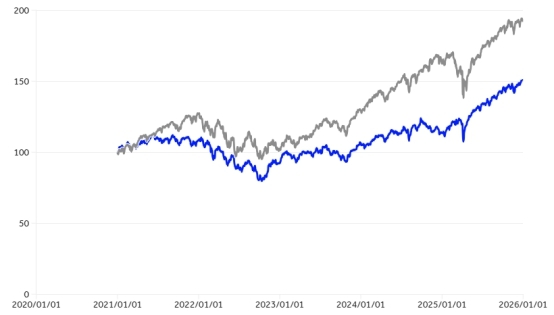
FTSE All-World ex US Index (in grey)v.s. FTSE USA Index (in blue). Graphics from London Stock Exchange Group.
More significant than outright de-dollarisation, however, are the improvements in cross-border settlement infrastructure. Platforms such as Project mBridge and other digital currency initiatives have significantly reduced settlement times and transaction costs.
The tide turns
“After more than a decade of U.S. outperformance, 2026 is emerging as a potential inflection point for global capital reallocation as several structural factors are expected to catalyze in 2026,” the research points out.
One is the persistence of yield differentials: real interest rates in emerging markets remain markedly higher than in developed economies. As the Federal Reserve edges further into an easing cycle, the resulting carry advantage is likely to draw sustained inflows into emerging-market debt and equities.
Another factor is institutional perception. Investors are increasingly viewing developed markets as sources of political turbulence -- particularly in the U.S., where fiscal dominance and legislative gridlock loom large, while many emerging markets are perceived to have orthodox monetary and fiscal discipline maintained especially through the post-pandemic cycle. According to the International Monetary Fund, GDP growth in developed economies is projected at 1.4% in 2025 and 1.6% in 2026, compared with 4.2% for emerging markets in 2025 and around 4% in 2027.
For the first time in recent cycles, emerging market earnings growth is projected to outpace or match that of developed markets. Over the next two years, emerging market earnings are expected to grow at a compound annual rate of roughly 14.9%, slightly ahead of the 14.5% projected for the S&P 500. Crucially, this growth is becoming more broad-based. Unlike in the U.S -- where more than 70% of earnings expansion has been concentrated in the technology sector -- emerging-market growth is increasingly diversified across financial, industrial and consumer sectors, spanning Asia-Pacific, South-East Asia and Latin America.
(Editor: fubo )